
Neurodiversity Inclusion at Work: Stop the Guesswork. Start working better together.
How a simple tool, My Work Profile, can transform team understanding and build a truly neuroinclusive workplace.
My Work Profile is a practical, self-guided neuroinclusive tool designed to help every employee clearly identify and articulate how they work best, so managers and teams can support them with confidence, not guesswork.
Workplaces are full of capable, well‑intentioned professionals who still find themselves misaligned, frustrated, or exhausted. More often than not, the issue isn’t performance or motivation, but a lack of shared understanding around how people work.
We expect employees to collaborate, communicate clearly, and perform well, and yet we rarely give them a safe, structured way to explain what they need to do their best work. Instead, we work with each other based on assumptions, unspoken rules, and guesswork.
Through years of neuroinclusive coaching and consultancy work, one thing has become clear: when people don't have to guess how to work together, trust and psychological safety naturally grow.
When people don’t have to guess how to work together, trust and psychological safety grow.
We focus on what gets done. Rarely on how.
Work is complex. Environments are stimulating, roles are fast-paced, and expectations often shift without warning. Many professionals carry a heavy cognitive and emotional load just trying to keep up, often without ever naming what's actually contributing to their stress.
The result? Behaviours get misread. Differences get pathologised. And the people who needed just a small adjustment burn out trying to bridge a gap nobody talked about.
Consider how differently people can function within the same role:
“One person processes information verbally; another needs it in writing.”
“One thrives with autonomy; another needs clear structure and timeframes.”
“One person appears quiet in meetings but has strong ideas once given time to think.”
None of these differences signal weakness or disengagement. They signal something far more useful: diversity of thought and process, if only it were visible.
My Work Profile creates the space for these differences to be named clearly and respectfully, building shared understanding across teams.

When people can't explain what they need, everyone pays the price.
When someone doesn't feel safe explaining how they work best, they default to coping. In our neuroinclusive coaching work, we see the same patterns emerge again and again:
masking discomfort or overload
overworking to compensate
staying silent to avoid drawing attention
pushing through at the expense of wellbeing
In neuroinclusive coaching, we regularly hear things like:
“I didn’t think I was allowed to ask for that.”
“I couldn’t put into words what wasn’t working.”
“I didn’t want to seem difficult.”
My Work Profile reduces this invisible load, by giving people the language to ask for what they need, before things reach a breaking point.
For example, instead of silently struggling, someone might name:
“I prefer written follow‑up after verbal discussions so I can refer back to it.”
“I work best on focused tasks in the morning and prefer meetings in the afternoon.”
“If possible, please let me know the purpose of meetings in advance so I can prepare.”
These are not demands, but insights into how people do their best work. And when they are visible, work becomes easier for everyone.
What is My Work Profile?
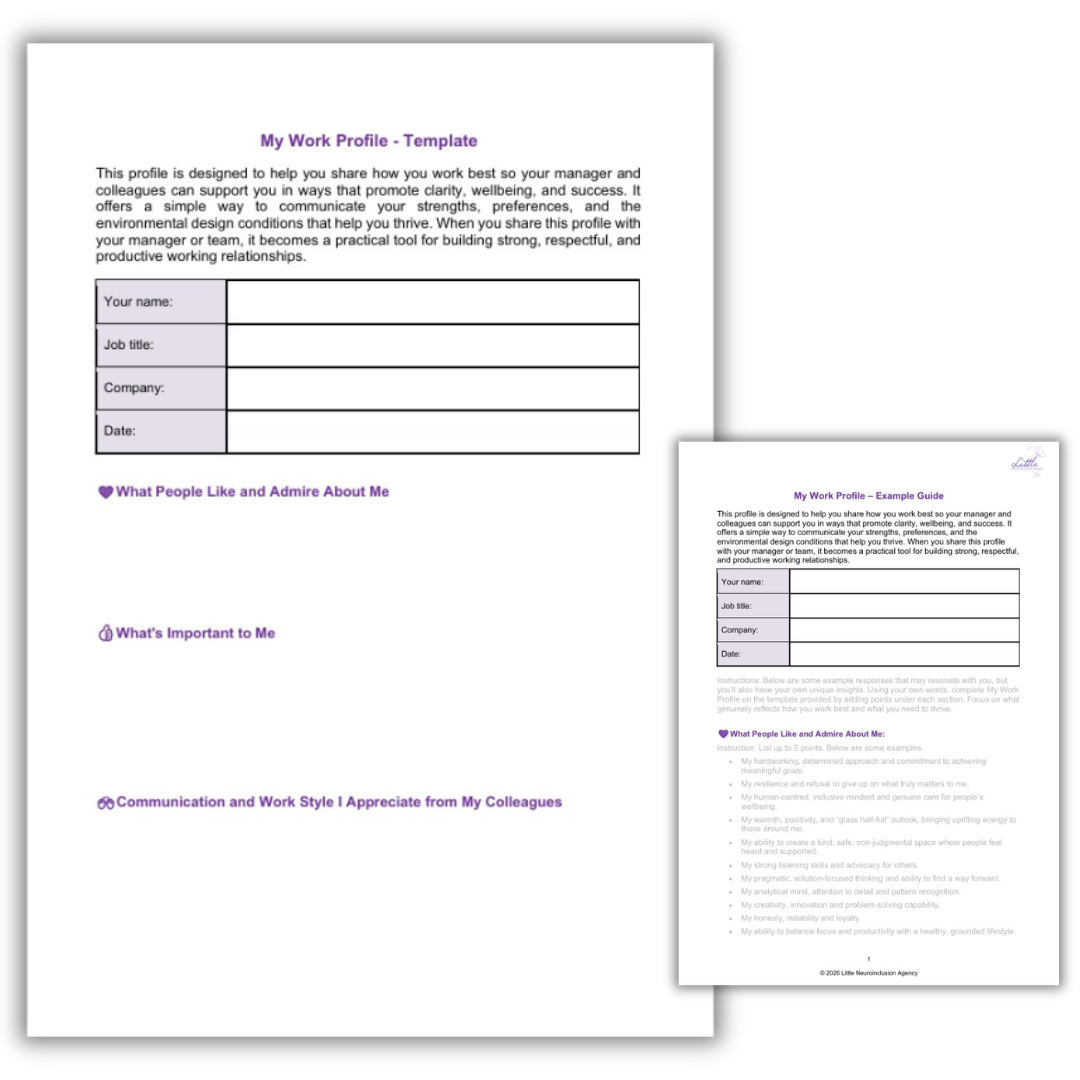
My Work Profile is a practical, self-guided resource that invites reflection across the areas most likely to create friction at work: communication, environment, wellbeing, learning, collaboration, and feedback.
Rather than asking people to disclose deeply personal information, the profile focuses on practical conditions for success. It's strengths-based, affirming, and designed for universal use, any employee, any level, any industry.
Here's a taste of the kinds of statements people include:
-
“I prefer written communication (email or Teams), especially to confirm verbal instructions.”
“I value acknowledgement of emails, even if brief.”
“If something is urgent, a message is better than a voicemail.”
-
“Loud or competing noise can be challenging, and noise‑cancelling headphones help.”
“I’m sensitive to heat and work better in air‑conditioned spaces.”
“I focus best when seated away from busy walkways.”
-
“I work best with set periods of focus followed by short breaks.”
“If I become quieter than usual, it may be a sign I’m overwhelmed.”
“Getting outside briefly helps me reset when I’m under pressure.”
These aren't demands. They're insights, and when they're visible, work becomes easier for everyone.
My Work Profile has been refined over years of real-world use, evolving alongside the increasing complexity of high-performing, neurodiverse workplaces. It bridges the gap between guesswork and genuine understanding.
How My Work Profile supports psychological safety
Psychological safety isn't built in grand gestures. It's built through everyday signals, small, consistent messages that tell employees it's safe to ask, safe to share, and safe to be authentic.
My Work Profile is one of those signals. By inviting everyone, not just neurodivergent employees, to reflect and share how they work best, it normalises difference and opens the door to honest, proactive communication.
My Work Profile supports psychological safety by:
showing that difference is normal and to be embraced
reducing ambiguity around work expectations
encouraging curiosity instead of judgement
making it safer to talk about wellbeing before crisis points arise
When someone can share "I need additional time to transition between tasks" or "if I miss details, please let me know so I can fix it," they're no longer relying on others to assume what they need.
And when leaders engage with these profiles thoughtfully, they model inclusive, human-centred leadership for the entire team.
Case Study: My Work Profile in Practice
Below is an example of My Work Profile in action, which shows how it affects how the employee works at a deep level.
“Alex works in a busy government department and is consistently described by his manager as capable, committed, and conscientious. He takes pride in producing high‑quality work and holds himself to very high standards.
Over time, however, this perfectionism began to work against him. Alex would spend significant time refining tasks to ensure they were done “properly,” often going deeper than was required.
As multiple pieces of work competed for his attention, he became increasingly overwhelmed and anxious about falling behind. From the outside, his manager could see that Alex was struggling, but without understanding what was driving the overwhelm, she was unsure how to support him without appearing to lower expectations or intervene unnecessarily.
Completing My Work Profile gave Alex language for things he had never clearly articulated at work before. He was able to explain that explicit instructions and clear expectations were critical, that he processed information best when tasks were broken into smaller steps, and that competing priorities were particularly challenging.
He also shared that guidance on what mattered most, along with indicative timeframes for tasks, helped him regulate how much time and energy he spent on each piece of work. Importantly, Alex was able to name that understanding what a good outcome looked like made a significant difference, as it helped him resist the urge to over‑perfect and permitted him to stop when the work was fit for purpose.
Once this Profile was shared, his manager adjusted how work was delegated by chunking tasks into clear components, outlining priorities, providing approximate time expectations, and describing what successful completion looked like.
As a result, Alex experienced significantly less overwhelm, felt safer asking for clarification, and was able to manage his workload more proactively. His manager also felt more confident supporting performance in a way that was structured, fair, and inclusive.
This wasn’t about special treatment; it was about understanding how Alex does his best work and being able to create the conditions to make that happen. ”

Built from lived experience, not just theory.
My Work Profile reflects decades of working alongside neurodivergent professionals and the managers who support them. It wasn't designed in a vacuum, it was shaped by real conversations, real workplaces, and real people navigating real friction.
We also use it within Little Neuroinclusion Agency itself. Because we believe in practising what we teach, and because it genuinely works.
When people feel understood at work, everything changes. Engagement rises. Communication improves. Trust deepens. And the team becomes more than the sum of its parts.
Want to get started?
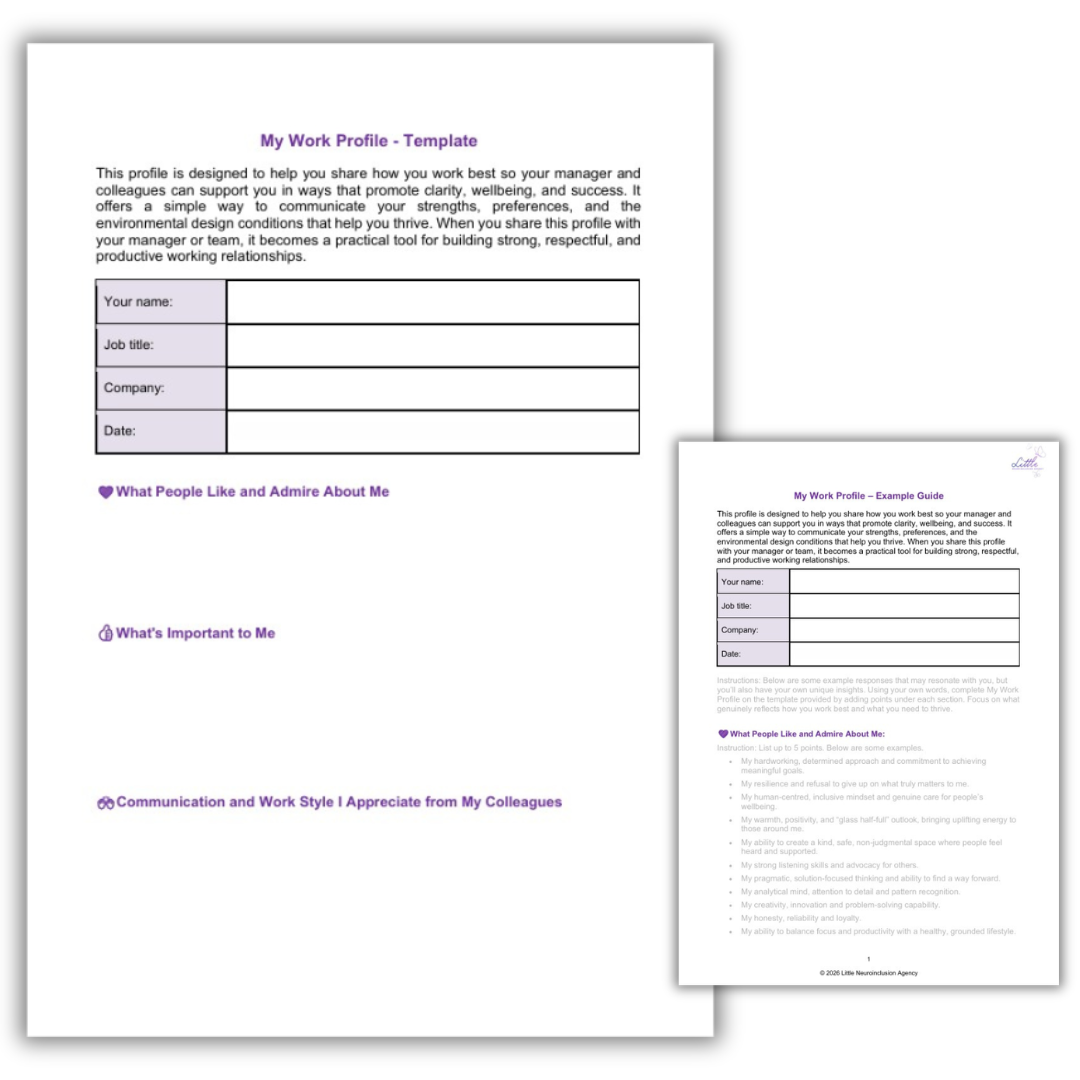
My Work Profile Template and Example Guide can be purchased as a digital downloaded.
Why not make a little step towards a more neuroinclusive team today?
