
Neuroinclusion and Psychological Safety at Work: Key Takeaways from our Neurodiversity Celebration Week Webinar
What does psychological safety really mean for neurodivergent employees? And what does it actually look like in practice, inside real workplaces, with real people?
These were the questions at the heart of our Neurodiversity Celebration Week webinar, Neurodivergence and Psychological Safety at Work: Enabling Neuroinclusion in the Workplace. We brought together a global audience of people leaders, People and Culture professionals, advocates and neurodivergent individuals to explore what meaningful neuroinclusion looks like, beyond the buzzwords, beyond the awareness days, and into the everyday actions that create genuine change.
We were honoured to be joined by two incredible panelists: Karl Perkins, a policy officer and autistic professional with lived experience at the centre of everything he contributes, and Fiona Scullion, Culture and Inclusion Specialist at Coles Group, who leads the accessibility portfolio as part of their Culture and Inclusion team. Our Founder and CEO, Vicky Little, also brought her own perspective, both as a 20-year practitioner in this space and as someone with lived experience of late-diagnosed ADHD.
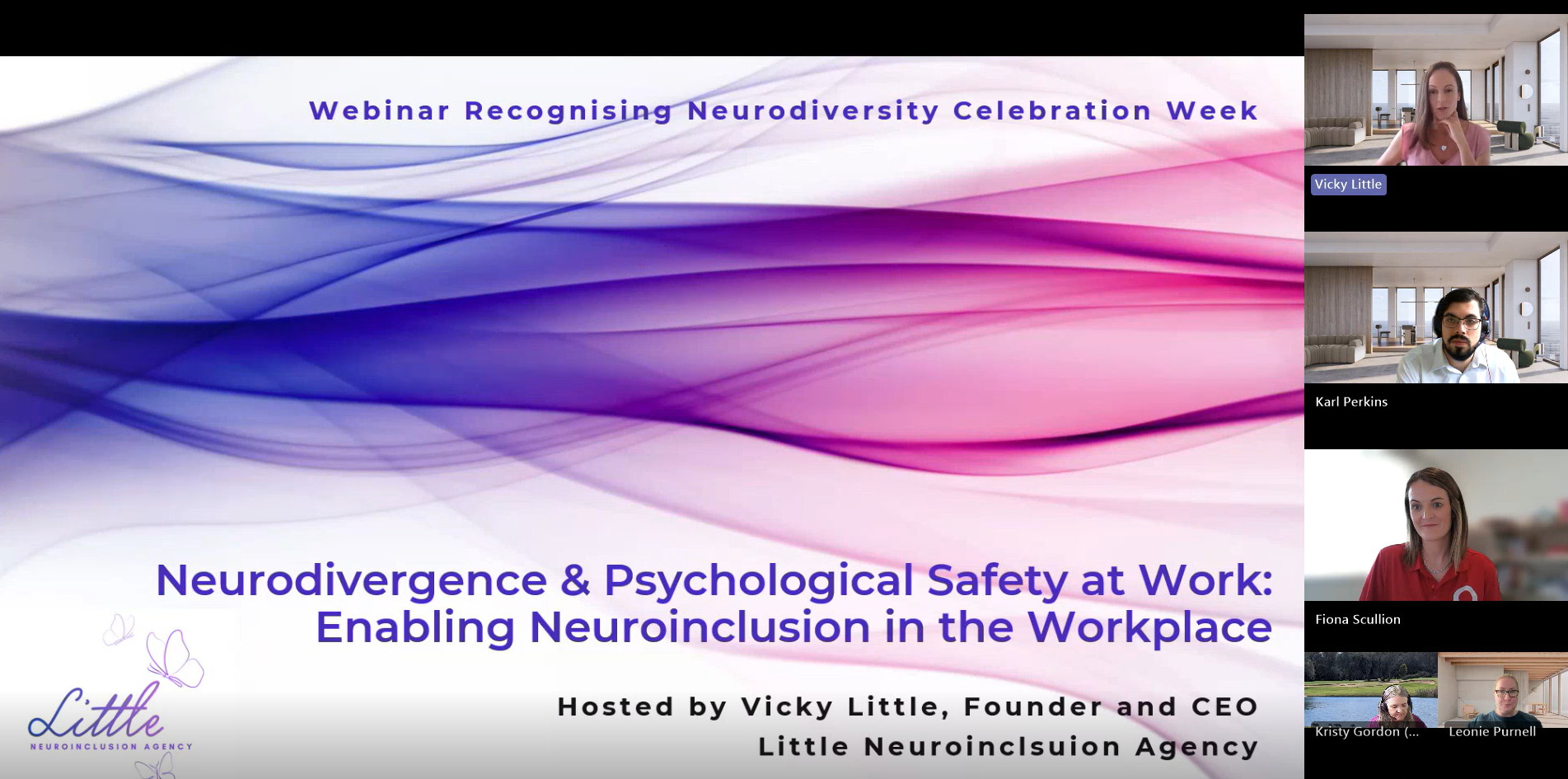
Here's what we explored, and what we hope you'll take back to your workplace.
What is neuroinclusion?
Before diving in, we grounded ourselves in a shared definition. Neuroinclusion involves consciously and actively including all types of information processing, learning and communication styles , all brains, across workplaces, education and communities.
I spoke about neuroinclusion as a journey, but it's also a destination: a state where all individuals have access to, and the capacity to maintain, meaningful employment , and where they feel valued, supported and safe at work.
Key Takeaways
1. Neuroinclusion is not niche, it's everyone's business
One of the most important things we can do is shift the framing. Neuroinclusion is not a conversation about a small cohort of employees. At least 1 in 5 people are neurodivergent, globally, and right here in Australia. That's already your current workforce.
Add to that the fact that 70–80% of neurodivergent individuals also experience intersecting mental health conditions, and the stakes become even clearer. This is a wellbeing and performance conversation for every organisation, regardless of size, sector or industry.
Karl spoke to this beautifully from his own experience working in the Australian Public Service and the disability sector. By approaching the world through a different lens, he has consistently been able to identify gaps, offer fresh perspectives and bring a depth of passion to his work that he attributes directly to his neurodivergence. "There are neurodivergent people with special interests who don't just bring a desire to do the job well, they bring a certain passion and love to that thing that you may not get anywhere else," he said.
That is the opportunity. And workplaces that aren't yet investing in neuroinclusion are leaving it on the table.
2. Psychological safety is the foundation, not a nice-to-have
You cannot have true neuroinclusion without psychological safety. It is the foundation on which everything else is built.
When we talk about psychological safety, we mean an environment where people feel safe to speak up, ask questions, share ideas and be themselves, without fear of judgment or negative consequences. For neurodivergent employees, the absence of that safety has measurable consequences.
Our recently co-authored white paper found that 43% of neurodivergent employees had already experienced burnout in the last 12 months. Separate research shows that 9 in 10 neurodivergent women report burnout in the past year. These are not individual failings. They are the result of workplaces still largely built around neurotypical norms that unintentionally exclude neurodivergent employees and contribute to higher rates of burnout, bullying and psychological distress.
Psychological safety, in a neuroinclusive context, means creating environments characterised by:
Clear, consistent communication
Role clarity and predictable structures
Sensory awareness
Genuine empathy
When these elements are present, we see totally different outcomes, higher engagement, stronger performance, greater confidence and improved wellbeing. The data is clear. The business case is clear. The human case is even clearer.
3. Leaders are the #1 driver of neuroinclusion
Time and again, in our white paper, in our coaching practice and in conversations with neurodivergent employees, one factor stands out above all others: the leader.
The culture of a team starts with how its leader shows up. An empathetic, curious, communicative leader can transform the experience of a neurodivergent employee. A leader who lacks awareness, even with the best intentions, can inadvertently create harm.
So what can leaders actually do? Here are the practical tools and behaviours we discussed:
Ask the person (ATP). Coined by Randy Lewis, this simple principle recognises that your neurodivergent employees are the experts of their own experience. Rather than assuming what someone needs, ask. It sounds simple because it is, and it changes everything.
Employee profiles. Every employee should have a profile that documents how they work best, how they communicate, how they process information and what they need to thrive. At Little Neuroinclusion, ours are strengths-based, they ask things like "what do people admire about me?" and cover practical needs like flexible hours, preferred meeting formats and energy management strategies. These profiles normalise adjustments for everyone, not just neurodivergent employees.
Flexible working arrangements. This goes beyond working from home. It includes flex time, sensory-friendly spaces, the ability to manage energy across the week and the flexibility to step back when sensory overload hits, without having to navigate complex leave processes. Karl described his own flex time arrangement as "working wonders" for balancing his life and his performance.
Clear, consistent communication. Follow up in writing. Be explicit. Reduce ambiguity. These aren't accommodations, they are good management practices that benefit every single person on your team.
Lead with vulnerability. When leaders share their own needs, adjustments and ways of working, it gives others permission to do the same. Modeling the culture you want to create is one of the most powerful tools a leader has.
Energy management. This is an underrated part of the neuroinclusion conversation. For many neurodivergent individuals, the cognitive and sensory load of the workplace, from open-plan offices to back-to-back meetings to three-day conferences, is genuinely exhausting in ways that can be hard to articulate. Great leaders ask: how can we manage energy? How can we create space for recovery? What does defragging after an intense week look like for each person on my team?
What Coles is doing in practice
Fiona gave us a fascinating window into how one of Australia's largest employers is approaching neuroinclusion, and the message was clear: it starts with small, intentional actions.
Coles has two external commitments on accessibility: increasing the representation and engagement of team members with disability (including neurodivergence), and creating a more accessible experience for both team members and customers. Underpinning all of it are their four values, care, customer, courage and create.
Some of the practical initiatives Fiona shared:
Celebrating days of significance. It might sound simple, but marking days like Neurodiversity Celebration Week sends a powerful signal to the business: we care, and we want to have this conversation. It creates the psychological safety for people to start sharing their own experiences.
The Disability and Neurodivergence Toolkit. Launched in June 2025, this practical resource was designed to help leaders and People & Culture teams have more confident, informed conversations about disability and neurodivergence. Developed with external partners including Australian Disability Network and Little Neuroinclusion, and tested with team members with lived experience, it focused on foundational principles, busting myths and giving leaders real, practical language to use.
"Listen to learn" sessions. One of the most impactful things Coles has done is bring a small, intimate group of neurodivergent team members together with senior leaders, not to present, not to report, but simply to listen. The impact was significant: neurodivergent team members felt psychologically safe to share, and leaders left better equipped to understand and support their teams.
Coles Ability. This internal network brings together team members with disability, neurodivergence and their carers as a safe space to connect, share stories and support one another. As Fiona noted, connection doesn't have to solve every problem, but it is a powerful starting point for building belonging.
Fiona was also candid about the fact that Coles is still on its journey. “We're not perfect," she said. "It's about creating that safe space for people to feel comfortable to speak up, and that takes time."
It works for small organisations too
We know that not every organisation has a dedicated Culture and Inclusion team or a large budget for toolkits and programs. And that's okay. The principles are the same regardless of size.
Start with celebrating days of significance, it costs nothing and signals genuine care. Build authentic, trusting relationships with your team members so that when people are ready to share, they feel safe to do so. Create informal spaces, during the working day, not outside it, where people can connect with others who share their experience. And remember that the most powerful change often starts with one leader choosing to show up differently.
Call to Action
We closed the session by asking each panelist for one thing they'd like the audience to take away.
"By creating that environment, that is when conversations can happen and people can feel more psychologically safe." — Karl Perkins
"Take the time to listen. It gives you practical insights and quick wins to build an even more inclusive culture." — Fiona Scullion
"Simply asking a colleague how you can support them better, that is not a neurodivergent-specific question. That is all humans." — Vicky Little
What's your next little step?
Our tagline at Little Neuroinclusion Agency is little steps toward neuroinclusion make a big difference, and we mean it. You don't need to overhaul your entire organisation overnight. You need one conversation, one profile, one moment of genuine curiosity about the person sitting across from you.
Whether you're a people leader, an HR professional, a neurodivergent individual navigating your own workplace, or simply someone who wants to do better, there is something you can do today.
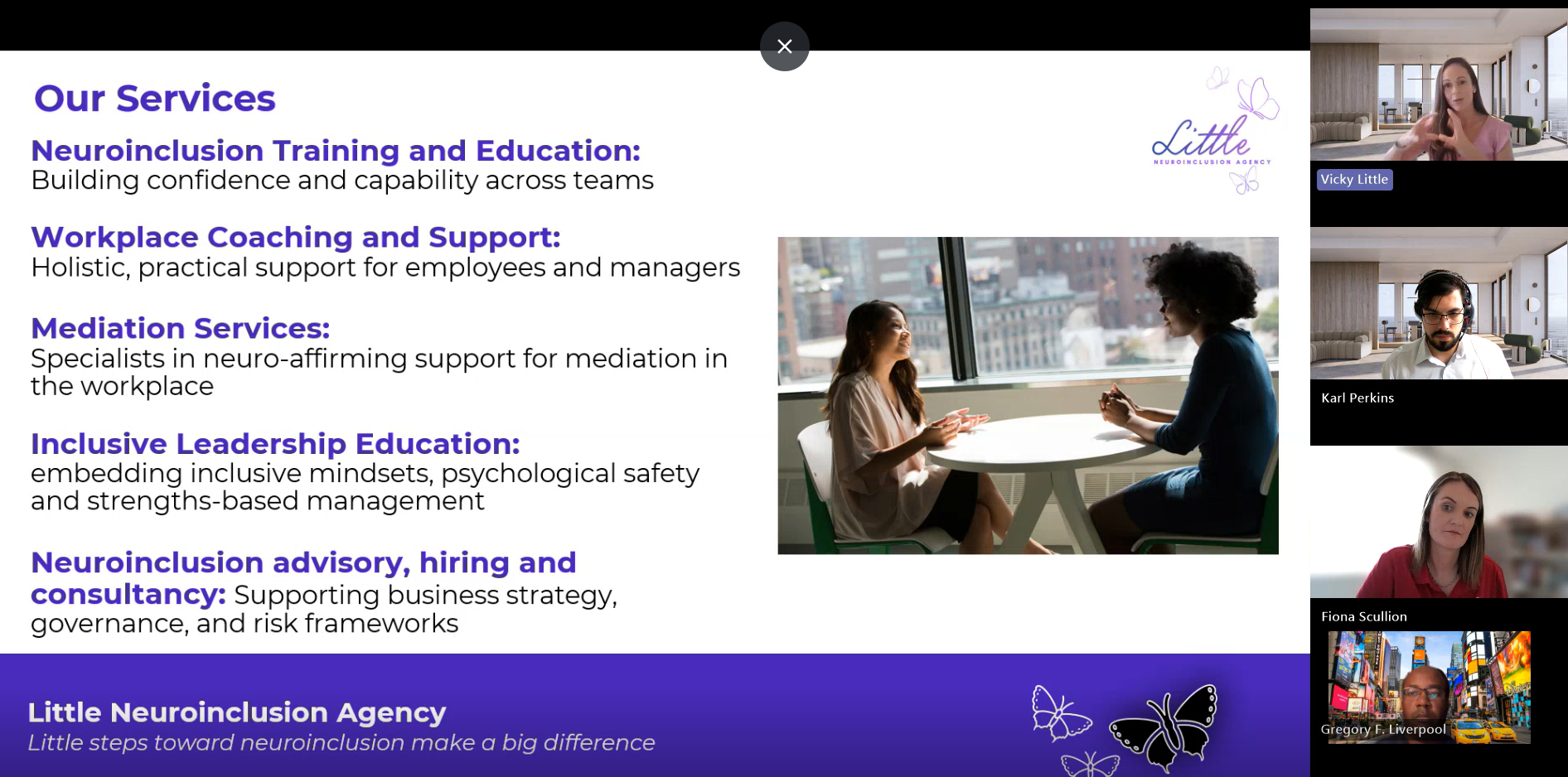
If this conversation resonated with you and you'd like to explore how Little Neuroinclusion Agency can support your workplace, through training and education, neurodiversity coaching, inclusive leadership programs or advisory and consulting services, we'd love to hear from you.
📩 admin@littleneuroinclusion.com.au 🔗LinkedIn 📄 Download our whitepaper
Together, let's make those little steps.
About Little Neuroinclusion Agency:
Little Neuroinclusion Agency works with organisations across Australia to create meaningful, lasting neuroinclusive workplaces. Founded by Vicky Little, we specialise in training and education, neurodiversity coaching, workplace support, and advisory and hiring services.
