
Commons Gaps Towards Neuroinclusion in the Workplace
Even in progressive and mature organisations, we continue to see four recurring neuroinclusion gaps:
Awareness without action
Supporting the employee, but not the manager
Performance management, without workplace adjustments
Reactive rather than proactive intervention
Closing them is what turns inclusion from an isolated activity into embedded neuroinclusion.
Many organisations make meaningful commitments to diversity, equity and inclusion, expanding their focus to include neuroinclusion. We regularly see organisations investing in neurodiversity awareness training and employee coaching, but quite often, the activity stops there.
Through our coaching, training and advisory work, we see consistent patterns emerge, even in organisations that are making positive progress towards neuroinclusion. The gaps are often about lack of intention, caused by uncertainty around where effort will have the most impact beyond initial initiatives.
Below are four of the most common neuroinclusion gaps we see, and what they mean for leaders seeking to move from awareness to impact.
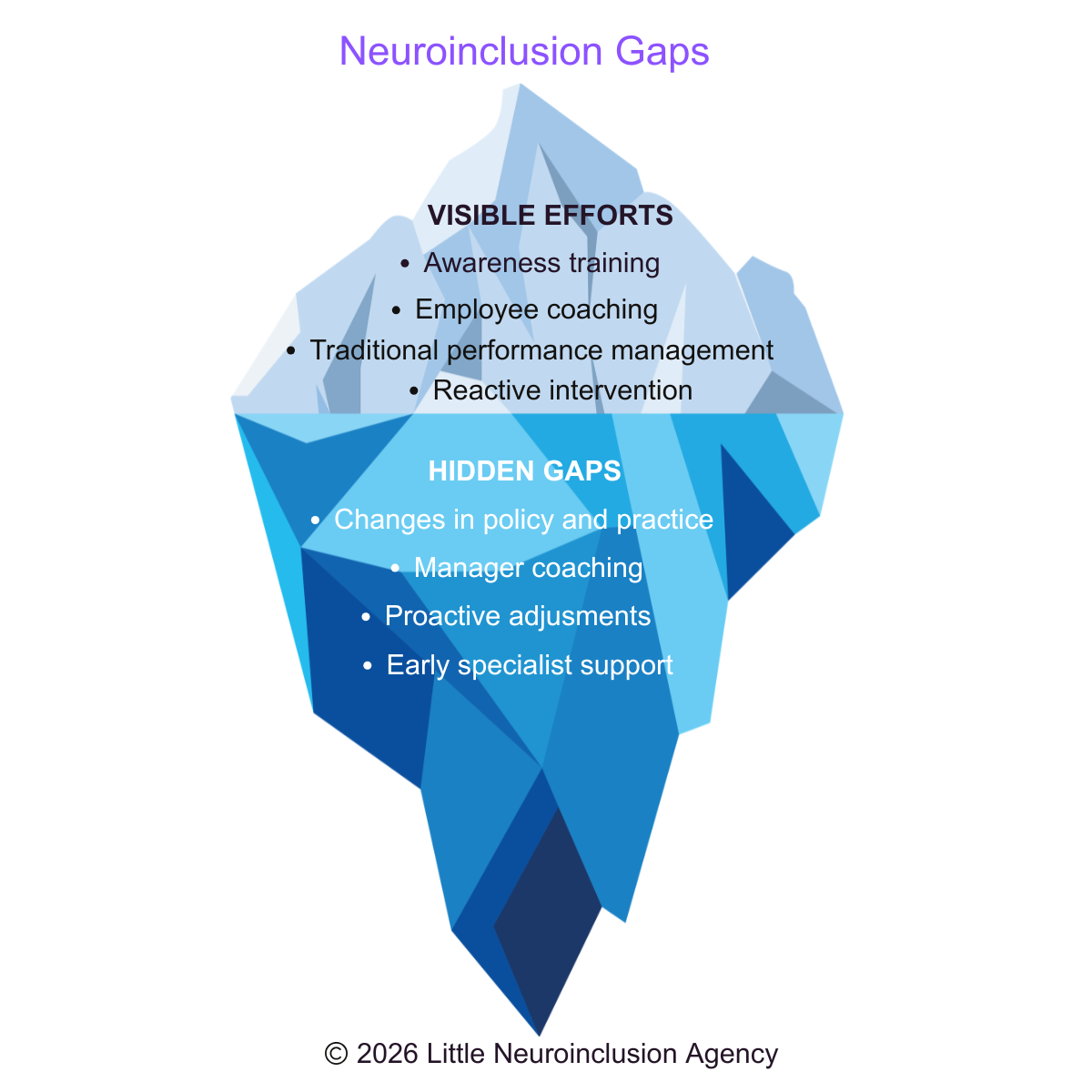
Iceberg split into two sections - above water is “visible efforts” and below water level is “hidden gaps”
Gap 1. Awareness Without Action
Awareness training is often the starting point for neuroinclusion, and it is an important one. However, many organisations stop there.
Employees may leave education sessions with greater understanding and empathy, but without reinforcement within the broader organisation, these insights may fail to translate into action. In many organisations policies remain unchanged, managers revert to prefered ways of leading, and systems continue to advantage certain ways of thinking and working over others.
Awareness alone does not shift behaviour at scale. Inclusion requires intentional integration into processes, leadership expectations, and organisational norms to have impact.
How to bridge the gap:
Awareness training needs follow-through. We recommend pairing awareness initiatives with tangible actions - reviewing policies and processes, embedding inclusive practices into performance frameworks, equipping leaders with coaching, support and practical tools, and measuring progress over time.
Treating neuroinclusion as ongoing and intentional capability-building, and not a one-off event, will help move an organisation towards true neuroinclusion.
Gap 2. Supporting The Employee, But Not The Manager
Many organisations rightly invest in coaching and development for neurodivergent employees. It is the most effective, sought-after and easily implemented support organisations can make. However, when this is done in isolation, critically, the broader organisation, and the direct manager, are left out of the equation.
Without equipping managers with the skills, confidence and context to lead neurodiverse teams effectively, the responsibility for inclusion falls disproportionately on the neurodivergent employee. This can reinforce the very inequities organisations should be trying to address.
Managers play a pivotal role in workload allocation, communication norms, feedback style, and creating psychological safety. If they are not provided coaching, support and capability development, even the most capable employee can struggle to have their needs met.
How to bridge the gap:
Organisations need to shift from employee only coaching to employee/manager coaching and support. When coaching an employee, consider concurrent coaching and capability-building for their manager.
Sustainable and intentional inclusion happens when both sides of the relationship evolve to have greater awareness and understanding.
Gap 3. Performance Management, Without Workplace Adjustments
One of the most consequential gaps we see is the sequence in which organisations act, particularly around performance management. Too often, formal performance processes are initiated before reasonable adjustments or workplace accommodations have been explored and put in place.
This creates a fundamental fairness issue. When expectations are not aligned with how someone processes information, communicates, or manages workload, performance concerns are quite often a reflection of context rather than capability.
Introducing performance management without first addressing these contextual barriers risks penalising employees for not having the support they need to succeed.
How to bridge the gap:
Embed an “adjustments first” principle. Before progressing to formal performance management, ensure that workplace accommodations, both formal and informal, have been explored, implemented and given time to trial and take effect. This creates a more inclusive and equitable approach to performance.
Gap 4. Reactive Rather Than Proactive Intervention
Another pattern we frequently observe is the timing of support. Specialist input, whether coaching, mediation, advice or neurodiversity-specific expertise, is often only sought after challenges have escalated.
By this point, issues may already be framed as performance concerns, behavioural problems, disengagement or team conflict. The employee may feel under scrutiny, and the manager may feel stuck to know how to handle the situation.
Early intervention, by contrast, is rarely about fixing problems. It is about unlocking strengths, clarifying expectations and setting up effective ways of working from the outset.
How to bridge the gap:
Normalise early access to neurodiversity specialist support. Position neurodiversity expertise as an enabler of performance and engagement and not as a remedial measure.
Building proactive pathways reduces escalation and most often creates better outcomes for everyone.
Moving Beyond Intent to Impact
The organisations we work with are not getting it wrong - they are often doing many things right. But neuroinclusion involves intentionally working on all layers of the organisation. Rather than isolated initiatives, it requires alignment across people, practices and systems.
Closing these gaps is less about doing more and more about doing things differently:
Supporting both individuals and their environments
Acting early, not just when challenges surface
Prioritising adjustments as a foundation for performance
Translating awareness into sustained organisational change
Acting with intention to move from ad hoc activity to planned integration of neurodiversity
For organisations, the opportunity is to move from pockets of good practice to embedded, systemic inclusion where neurodiverse teams are not only supported, but truly thrive.
Want to build a neuroinclusive workplace?
Little Neuroinclusion Agency partners with organisations to bring these elements to life through sustainable, practical, human‑centred strategies that transform culture from the inside out.
👉 Learn more about our executive and leadership coaching and advisory here.