
Six Senior Leadership Behaviours That Shape Inclusive Culture
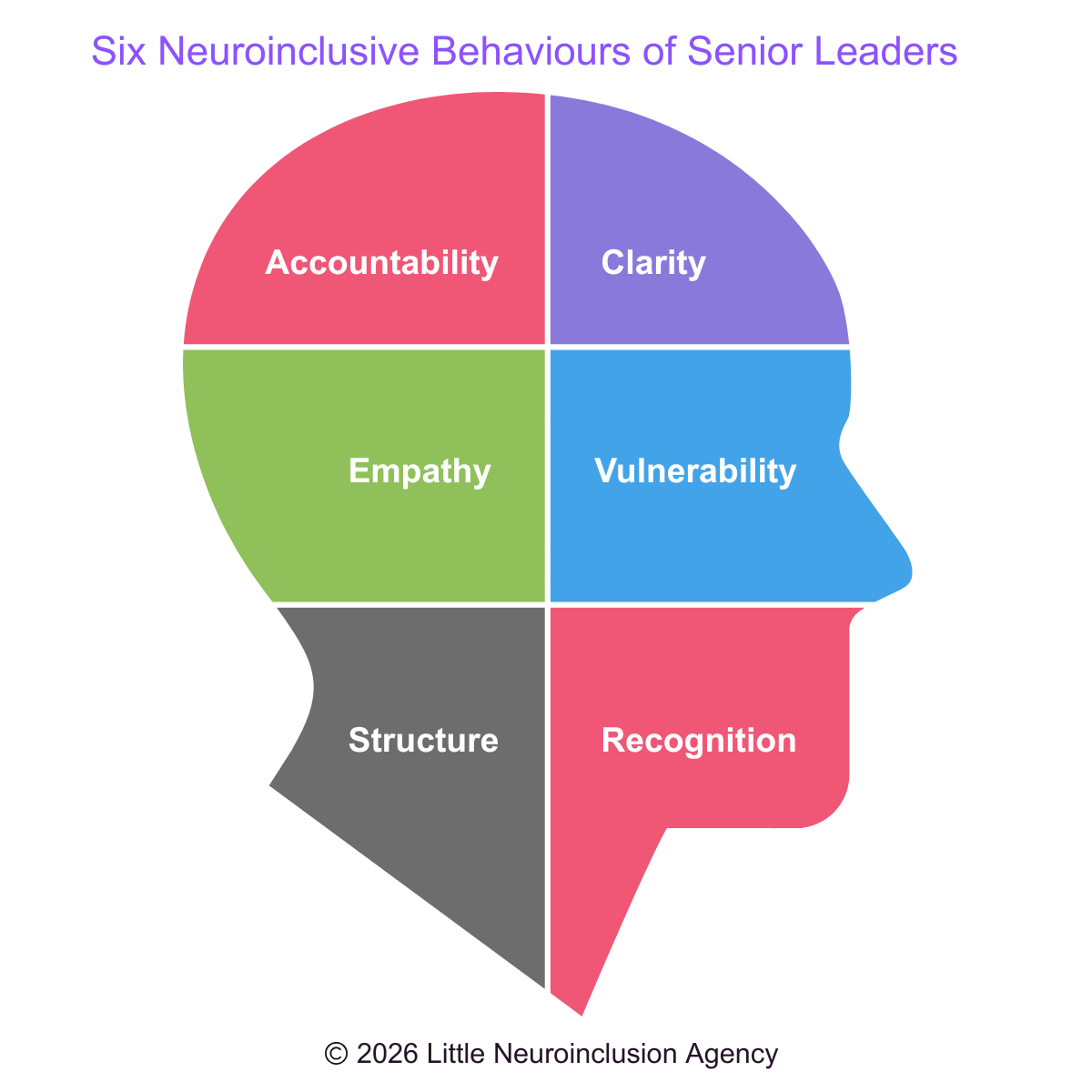
Senior leaders shape inclusive culture through six core behaviours: accountability, clarity, empathy, vulnerability, structure and recognition.
When these behaviours are practised with intention, they create workplaces where people feel respected, supported and able to thrive.
At the executive level, every decision influences culture, expectations, and how people experience the organisation. Neuroinclusive leadership isn’t about adding another initiative or layer to how you lead; it’s about leading in ways that make inclusion part of everyday actions and decision-making.
In our experience working with countless leaders in all types of organisations, we see that inclusive leadership benefits everyone, not only those who are neurodivergent, and makes leaders better all round.
The behaviours of leaders that are neuroinclusive fall into six areas and, when modelled consistently, have a profound impact on individuals and the organisation.
These six behaviours help senior leaders translate inclusion principles into confident, consistent action.
1. Accountability
Own decisions and their impact.
At the executive level, accountability means sharing decisions transparently, even when things are not clear to you. It’s how you build trust across layers of leadership and reduce fear of inconsistency.
Accountability is modelled by:
Explaining the reasoning behind decisions, especially when they are unpopular or challenging.
Acknowledging when outcomes didn’t match intent and sharing what you learned.
Inviting your direct reports to challenge assumptions safely.
Executives who model accountability create a culture where people leaders feel permission to do the same.
2. Clarity
Set clear expectations, goals and boundaries.
Executives often lead through complexity, where ambiguity can cause confusion. Clarity is the antidote, as it gives people leaders the confidence to act without second‑guessing or fear of repercussions.
Clarity is modelled by:
Defining what flexibility and fairness mean at an organisational level.
Simplifying or minimising strategic priorities to reduce cognitive load.
Communicating expectations through consistent frameworks, not ad‑hoc conversations.
Clarity from the top prevents overwhelm in the leadership team and helps to embed neuroinclusion in everyday actions.
3. Empathy
Lead with integrity and understanding.
Empathy is about considering the human impact of decisions before they’re made. Decisions won’t always be popular, but when they’re shaped with awareness of their human impact, they can be delivered in a way that feels thoughtful and respectful.
Empathy is modelled by:
Asking how proposed changes will affect different thinking styles, capacities and ways of working.
Listening for patterns of stress or disengagement across departments.
Balancing compassion with accountability; fairness doesn’t mean sameness.
Empathy helps executives lead the organisation with integrity, creating a culture that people want to be a part of.
4. Vulnerability
Share uncertainty and emotion.
Senior leaders rarely have a psychologically safe space to admit uncertainty. Yet being vulnerable is what makes leadership human-centred and credible.
Vulnerability is modelled by:
Admitting that you don’t always have the answers and being open to others’ ideas.
Sharing how you are feeling when things are difficult or challenging.
Taking care of your wellbeing and showing others that this is imperative for them too.
When leaders model vulnerability, it signals that learning, growing and evolving are inherent requirements of good leadership.
5. Structure
Provide clear decision-making and feedback structures.
Leaders set the tone for how structure within the organisation supports or stifles inclusion. Predictability and structure reduce anxiety and enable innovation and risk-taking.
Structure is modelled by:
Establishing consistent communication rhythms such as monthly reflections or quarterly listening sessions.
Using structured frameworks for feedback and decision‑making, which are made clear to the leadership team.
Ensuring people leaders have clear escalation pathways for complex situations.
Structure gives others the confidence to act inclusively without fear of inconsistency or backlash.
6. Recognition
Celebrate diverse skills and successes.
Executives shape what success looks like in an organisation. When recognition is narrow, it excludes others who may not fit into the traditional view of success. When success looks different, in different settings, and for different people, diverse cultures thrive.
Recognition is modelled by:
Highlighting different forms of contribution such as strategic thinking, empathy or innovation.
Publicly acknowledging and valuing different perspectives.
Linking recognition to organisational values such as inclusion and belonging, and not just metrics.
Recognition from the top tells every employee that their way of thinking belongs here.
Neuroinclusive leadership at the senior level isn’t about knowing every answer, but about creating clarity, empathy, and accountability so others can thrive.
When senior leaders model these six behaviours, they turn inclusion from a concept into a culture that’s human-centred and inclusive by nature.
Want to build a neuroinclusive workplace?
Little Neuroinclusion Agency partners with organisations to bring these elements to life through sustainable, practical, human‑centred strategies that transform culture from the inside out.
👉 Learn more about our executive and leadership coaching and advisory here.