
A Practical Framework for Inclusive Communication and the Diverse Ideas You're Currently Missing
You're losing good ideas in every meeting, and you probably don’t know which ones.
Research consistently shows that diverse thinking leads to better decisions, but only when those diverse thinkers actually get to speak. In most workplace meetings, they don't. Not because they have nothing to say. Because the conditions aren't set up for them to say it.
Sound familiar?
You ask your team for input during a meeting. A couple of people immediately jump in, usually the same people. Others stay quiet, and there’s an assumption they have nothing to add, so you move on.
Later, in a one-on-one, someone says: “I actually had a different view. I just didn’t get a chance to share it.”
That’s not a participation problem. That’s an inclusive communication problem.
Under time pressure, it’s easy to default to communication habits that unintentionally exclude. The loudest voices get heard. The rest get overlooked. And over time, that shapes not just who speaks in meetings, but who bothers trying.
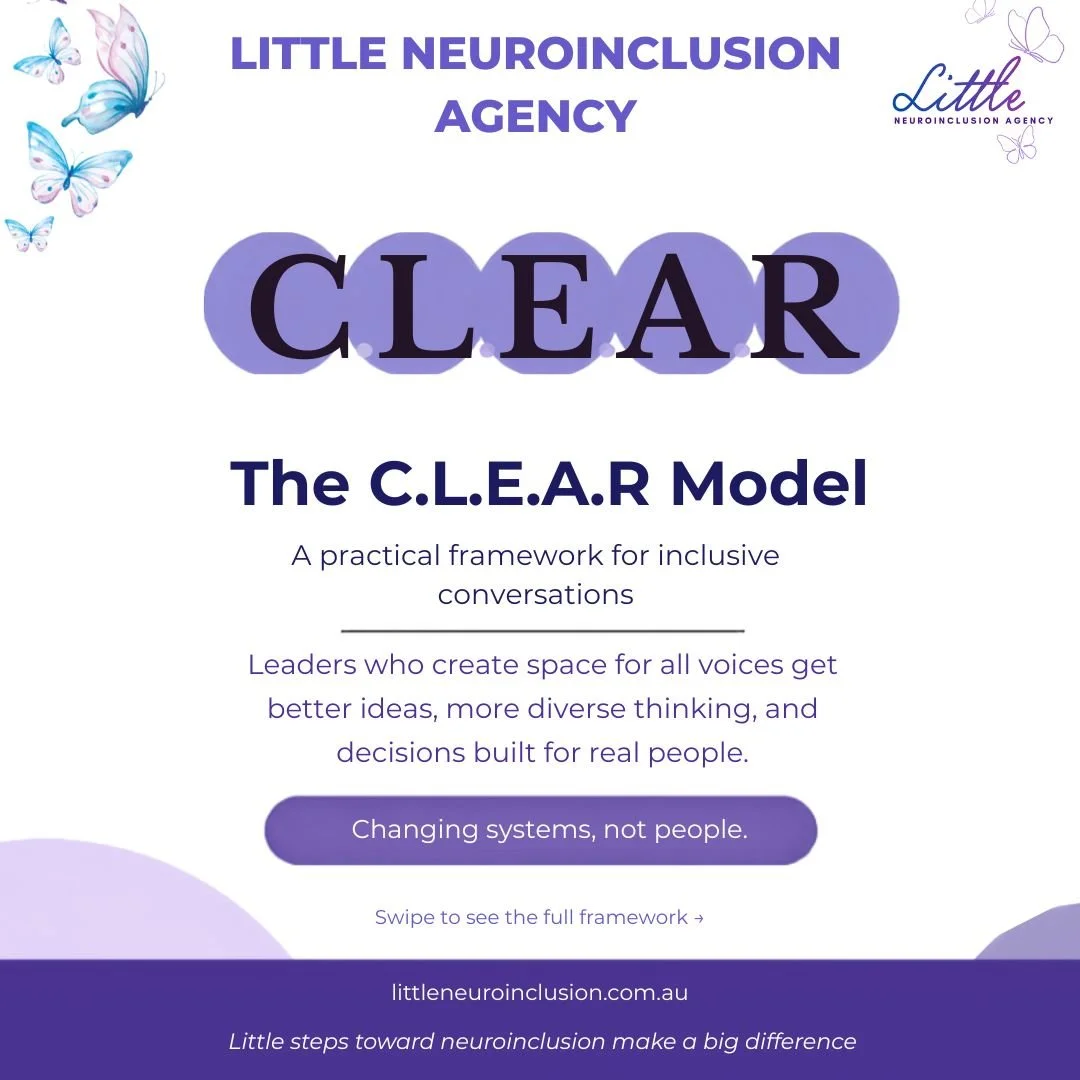
This is where the C.L.E.A.R model comes in.
The C.L.E.A.R Model for Inclusive Conversations
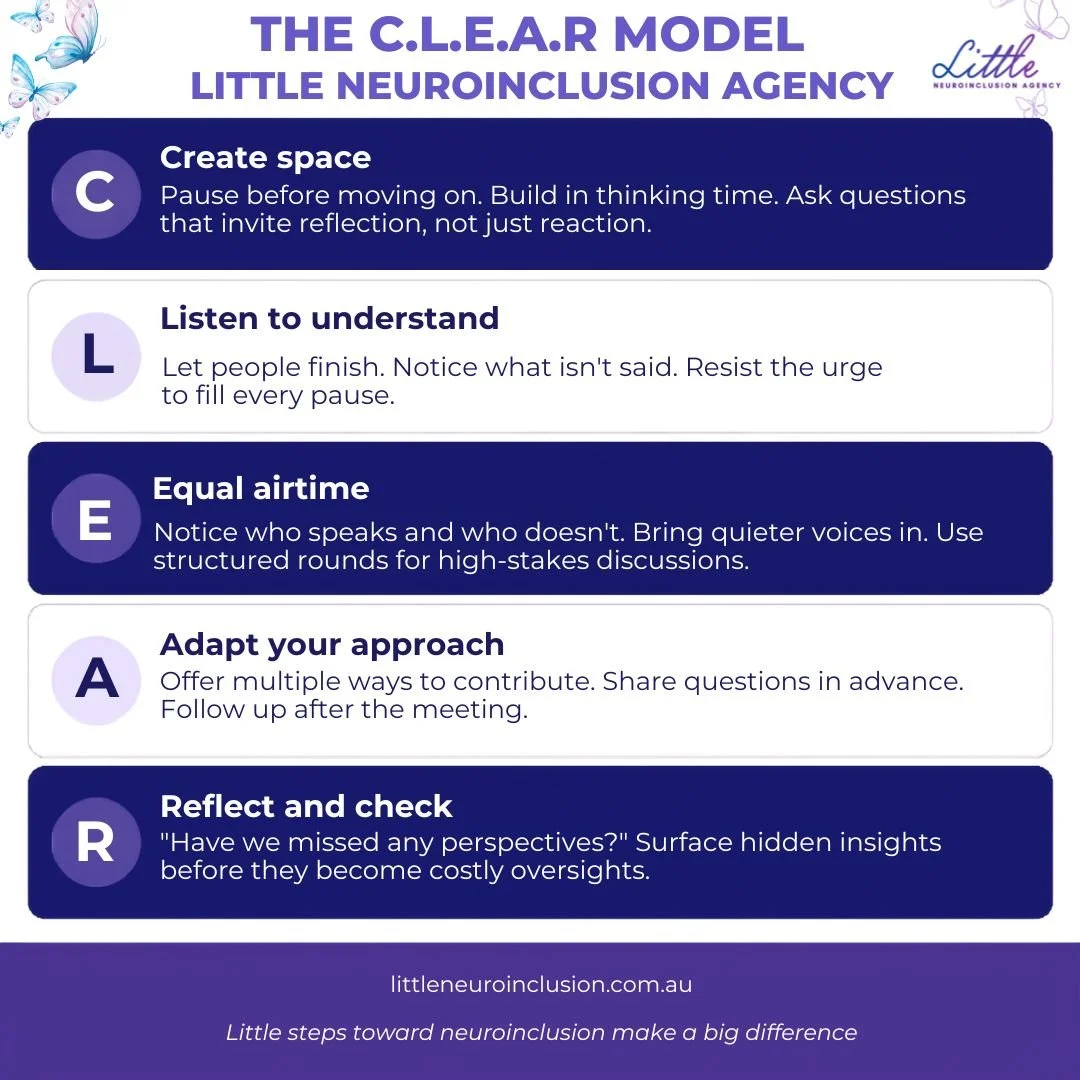
C: Create space
In fast-paced discussions, space doesn’t happen by accident You have to build it deliberately.
Pause before moving on to the next agenda item
Build in thinking time before asking for responses
Ask questions that invite reflection, not just reaction
"In my work with leaders, one of the most powerful shifts I see is when they stop filling every pause. Silence in a meeting isn't failure, it's thinking. Inclusion often starts not with what you say, but with what you stop saying long enough to let others begin." - Vicky Little, Founder and CEO, Little Neuroinclusion Agency
L: Listen to understand
Many leaders listen with the intent to respond, solve, or move things forward.
Inclusive leaders listen differently:
They let people finish before responding
They notice what isn’t being said
They resist the urge to fill every gap
Team members can feel the difference, and it directly shapes whether they speak up again.
E: Equal airtime
In most teams, a small number of voices dominate. This isn't because others lack insight. It's because the structure doesn't create equitable conditions for contribution.
Notice who speaks often and who rarely contributes
Gently bring in quieter voices
Use structured rounds when needed
Equal time to contribute leads to more diverse thinking in the team, and better quality decisions.
A: Adapt approach
Not everyone processes information the same way. Some people think best in the moment. Others need time to reflect before they can articulate a view clearly.
Inclusive leaders offer multiple pathways to contribute:
Share questions or discussion topics in advance
Invite written input via chat, shared documents, or polls
Follow up after meetings for input from those who didn't speak
This isn't about treating everyone the same. It's about giving everyone a genuine opportunity to contribute in the way that works for them.
R: Reflect and check
Before closing out any significant discussion, build in a moment to check for gaps:
“Have we missed any perspectives here?”
“Does anyone see this differently?”
“What concerns might we be overlooking?”
This is where the hidden insights surface, the ones that prevent costly oversights downstream.
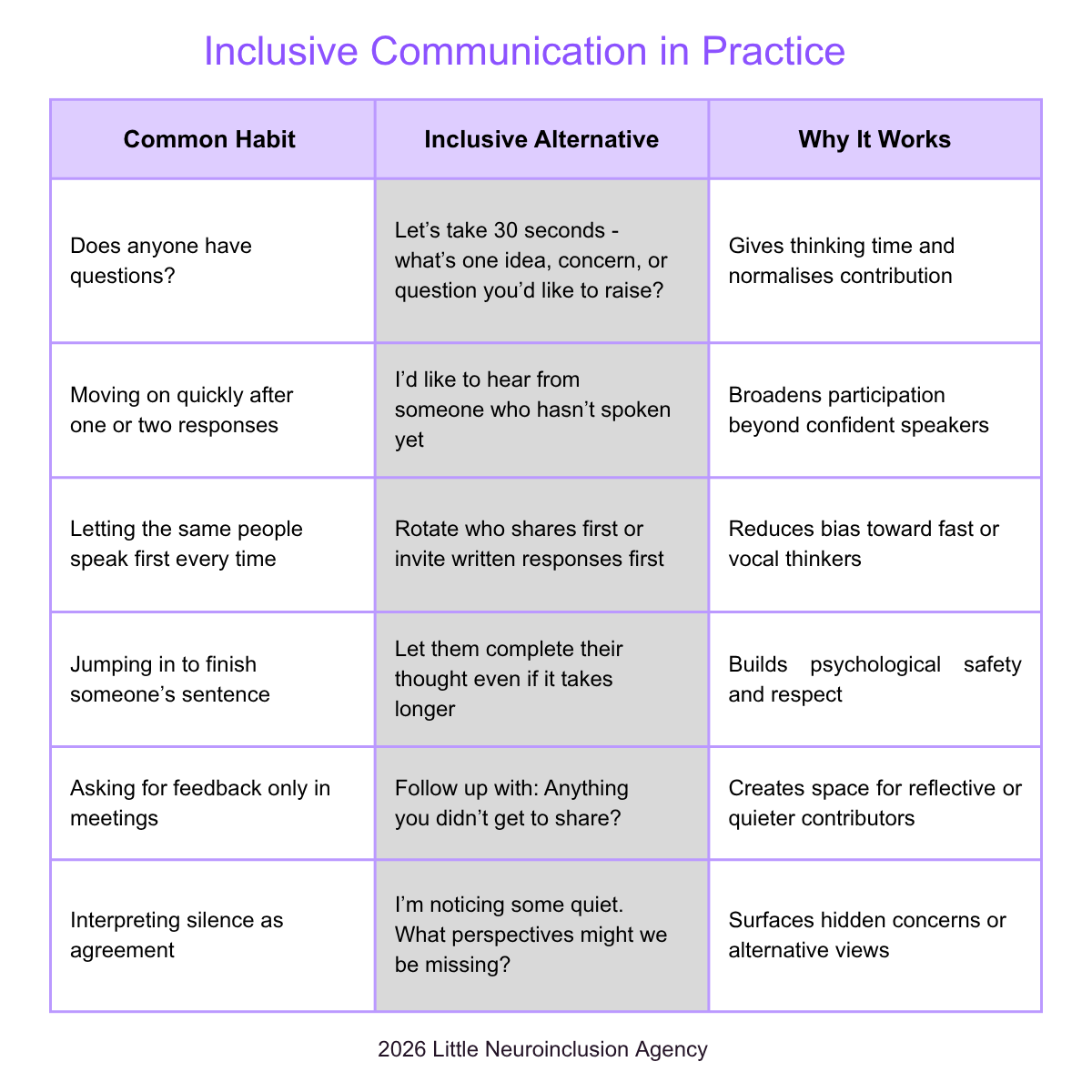
Inclusive communication in practice
Use this table below to identify common communication habits that might be limiting contribution of all voices and brains in your team.
A quick self-reflection
After your next team meeting or conversation, ask yourself:
Did the same 2–3 people do most of the talking?
Did I interrupt or rush anyone?
Did I assume silence meant agreement?
If yes, there's an inclusive communication issue. And the good news: it's fixable at the leadership level, without restructuring your team or overhauling your culture overnight.
Five actions to try this week
These small shifts can make a big difference to who contributes.
Pause for 3–5 seconds before responding or moving on
Invite written input (chat, polls, or shared document before or after)
Rotate who speaks first in meetings
Share discussion questions in advance so people can come prepared
Follow up one-on-one after meetings to capture perspectives that didn't surface in the room
The Business Case for Inclusive Communication
Inclusive communication isn't a soft skill add-on. It's how leaders access the full capability of their teams.
When you structure conversations so more voices are heard, not just the loudest ones, you get better ideas, more honest challenge, and decisions that are more likely to stick. You also build the kind of environment where people feel safe to raise concerns early, before they become expensive problems.
Over time, these habits don't just improve meetings. They build the psychological safety that underpins high-performing teams.
Because inclusion isn't about who speaks loudest. It's about whether your leadership creates the conditions for everyone to contribute, and whether you're currently leaving capability on the table.
Want to build this capability across your leadership team?
Little Neuroinclusion Agency partners with organisations to embed neuroinclusive communication and leadership practices in a way that's practical, sustainable, and grounded in real workplace contexts.
👉 Learn more about our executive and leadership coaching and advisory here.